
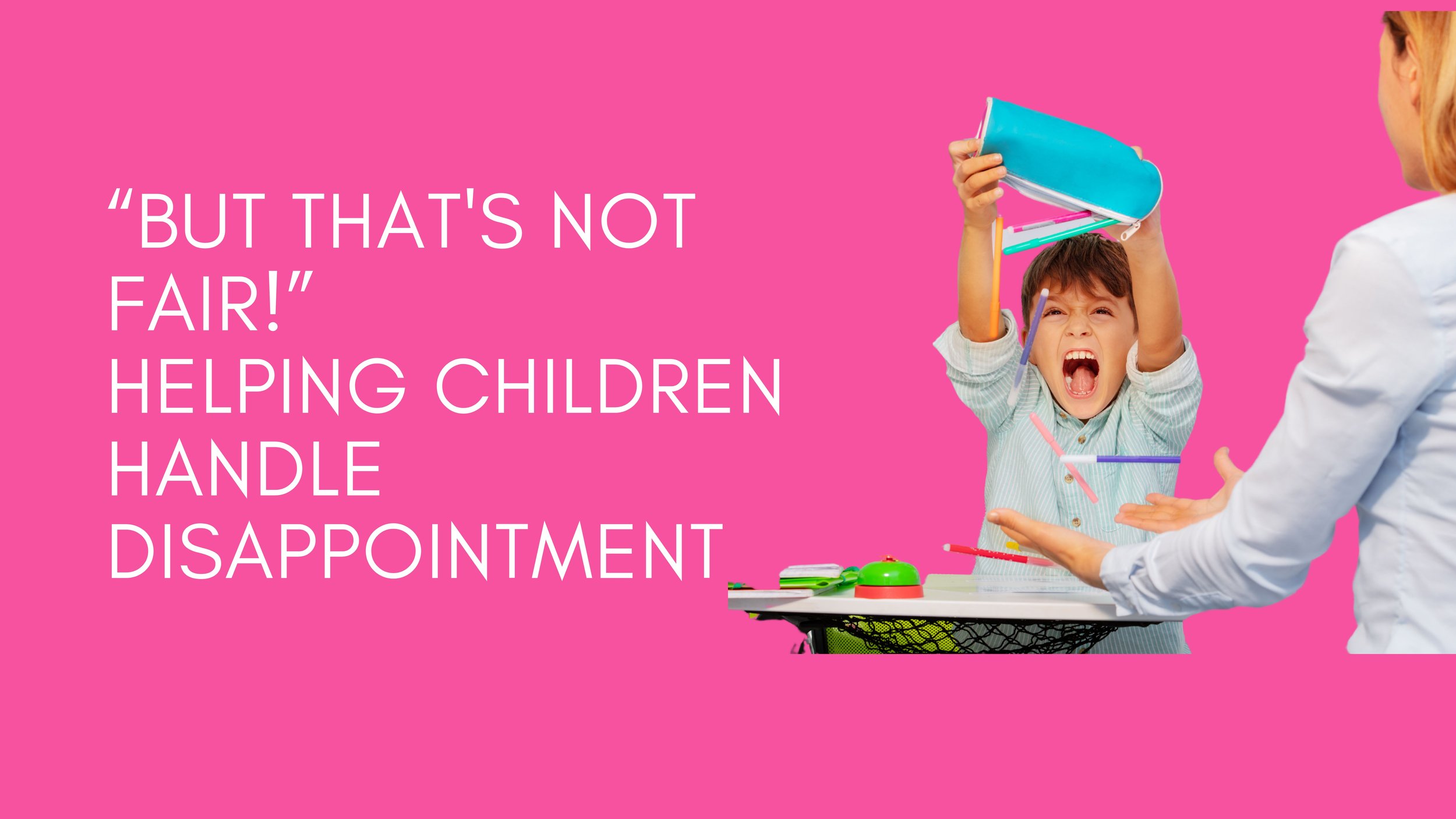
“But that's not fair!” Helping children handle disappointment
You’ve said no to another biscuit.
Your child would now like to appeal the decision, question your qualifications and speak to the manager.
Unfortunately, you are also the manager.
Or perhaps it is the board game they didn't win. The friend who can't come round. The screen that needs switching off. The plan that changed after they had already pictured exactly how the afternoon was going to go.
“But that's not fair!”
Sometimes it comes with tears. Sometimes with shouting. Sometimes with a dramatic departure that leaves you wondering whether the hallway has become an audition for a soap opera.
It can be hard to know how to respond. You want your child to learn that they can't always have what they want. You also don't want to dismiss a feeling that is clearly enormous to them.
And, if we're being honest, you would quite like to get through one ordinary evening without defending your position on biscuits.
Helping children handle disappointment means supporting them through something they genuinely dislike. There’s room for understanding, necessary boundaries and practice, even when the first attempts are decidedly wonky.
Why something small can feel so big
From the outside, the disappointment might look minor. There will be another game. They can see their friend another day. Everyone got a reasonable amount of cake.
But your child may have been expecting something very specific. They had pictured winning, going first or having the afternoon they were promised. Now reality looks different, and adjusting to that can be difficult.
Sometimes there is more attached to the moment than we realise. Losing might feel embarrassing. A sibling getting a different privilege might bring up a worry about being less important. A changed plan might mean losing something they were relying on to make the day feel predictable.
Those are possibilities to explore, rather than explanations to assume.
We adults have our versions too. The cancelled plan you were looking forward to. The delivery that doesn't arrive. The message saying your appointment has been moved when you have already rearranged half your life.
We may express it differently, but “this is not how I thought it would go” can still sting.
Children are learning how to handle that gap between what they wanted and what happened. Some will need more help, time or predictability than others.
Before you explain fairness, find out what feels unfair
“That's not fair” can mean several things.
“They got more than me.”
“I thought you said we could.”
“I don't understand the rule.”
“I wanted that so much.”
Sometimes something really does need checking. Perhaps the instructions were unclear, a promise was forgotten or a sibling is repeatedly being allowed to do something hurtful.
We don't need to teach children to accept every situation unquestioningly. If something has been unfair, we can listen and put it right where possible.
At a settled moment, you might ask:“Which part felt unfair to you?”
That helps you to understand whether there is a problem to solve, an expectation to clarify or a disappointment your child needs support with.
Fairness also doesn't always mean everyone gets exactly the same thing. A younger sibling may need help with something an older child can manage. Bedtimes and privileges may differ with age. Explaining that is usually easier before the disagreement or afterwards, rather than while everyone is loudly counting each other's chips.

You can understand the feeling and keep the boundary
A child being upset can make us question ourselves. Should I give in? Am I being too strict? Am I making this harder than it needs to be?
Start by checking whether the limit is reasonable. A considered change of mind is allowed. You can say, “I've thought about it, and I wasn't clear earlier. Here's what we'll do.”
When the boundary is necessary, acknowledge the disappointment and state the answer simply:
“You were hoping for another biscuit. We're finished with biscuits today.”
“You wanted longer on the game. Screen time is finished now.”
“I know you wanted to go first. It's your sister's turn this time.”
Your child may still object. Your lovely, thoughtful sentence may receive a review of zero stars. That doesn't automatically mean you said it wrong. Being understood doesn't make an unwanted answer suddenly welcome. You can remain warm, offer support and let them have their feeling. You do not need to keep finding new explanations until they approve the decision.
Help them through the disappointment safely
There is a difference between feeling angry and hurting someone. A child can be furious about losing but hitting another player still needs to be stopped.
You might say:
“You're really cross. I won't let you hit. I'm moving back and giving us some space.”
Keep other people safe and use words that fit the situation. If a game is becoming too much, pause it. If your child is upset, offer support without insisting on a particular response:
“Would you like me nearby, or a little space? I'll be here.”
Some children welcome company or a cuddle. Others need less input. Where safe, let their preferences guide you rather than assuming the same approach will help every time.
Once the moment has passed, there may be something to put right: checking on a sibling, picking up pieces or working out what to do differently next time. You can support that without turning the disappointment itself into something shameful.
Be careful with the rush to cheer them up
“I'll get you something else.”
“Don't worry, we'll do something even better.”
“Look on the bright side!”
We mean well. Watching our child feel sad or disappointed can be uncomfortable, and we want to make it better quickly. Sometimes an alternative is genuinely helpful. But we can also leave a little room for the original disappointment before moving on.
“You were really looking forward to seeing her. It's disappointing that she can't come.”
You don't have to promise a superior afternoon to make that feeling acceptable. You can be with them, let them feel what they feel and discuss a next step when they are ready. That next step might be finding another activity, rearranging the visit or simply having a quieter afternoon than planned.
Practise in ordinary, manageable moments
Children get opportunities to practise disappointment through daily life: waiting for a turn, trying something difficult, finishing an activity or playing a game where someone else wins. Choose moments your child can reasonably manage with support. There is no need to create surprise disappointments, change promises or make an activity harder just to teach a lesson.
For board games, choose something short and suited to their ability. Cooperative games like a puzzle or a treasure hunt can be a useful starting point if competitive play regularly becomes overwhelming. When you do play competitively, discuss the possibility of losing beforehand:
“One of us will win this time. What might help if you're disappointed?”
Make the plan together. They might want a short break, your company or a simple phrase such as “I wanted to win, and I can try again.”
If it becomes too much, stop and rethink. Support can be adjusted; every attempt doesn't need to be pushed through to the bitter end.
Let them see how you handle it too
We’re very good at telling children to be gracious when they lose. Then the Wi-Fi drops out and some of us immediately fall from grace. You can model disappointment in ordinary, proportionate ways:
“I was looking forward to that. I'm disappointed it's cancelled. I'll give myself a minute, then think about what we can do.”
Or, during a game:
“Oh, I wanted to win that round! Shall we play another?”
You can also demonstrate putting something right: “I snapped because I was frustrated. I shouldn't have spoken to you like that.”
Your child doesn't need to manage your feelings. They can simply see that disappointment happens to adults too, and that there are ways to respond and move forward.
Notice coping, even if they are still cross
Progress doesn't have to look like your child smiling graciously while losing at Uno.
Perhaps they were upset but asked for a break. Perhaps they stopped the game with your help. Perhaps they told you what felt unfair instead of pushing their sibling.
Make sure your feedback is specific:
“You really wanted to win, and you kept the cards on the table. That was tricky.”
“You told me you needed a minute. That helped me understand.”
The feeling may remain but you’re noticing and commenting on how they handled it, rather than rewarding them for hiding it.
There may not be complete consistency. A tired evening may be harder than a relaxed weekend morning, and one difficult day doesn't erase what they have been practising.
When your family needs more support
If reactions are regularly causing harm, significantly affecting everyday life or leaving you worried about your child's wellbeing, speak with their school, GP or an appropriately qualified professional. Some children need more individual support or adjustments to the situations they are finding difficult.
You don't have to keep guessing on your own.
Big Reactions is my practical, two-part programme for parents or carers and children aged 7–11, at The Royal Wells Hotel, Tunbridge Wells.
You attend the first workshop yourself: a chance to understand more, ask questions, connect with other parents and enjoy a guided relaxation. You then return with your child to explore tools together and begin creating your own Big Reactions Plan, with printed resources to use at home.
Children won't be expected to explain their behaviour or share personal experiences in front of the group. They can work alongside you, with different ways to participate.
Parents-only workshop: Monday 2 November, 7pm.
Parent-and-child workshop: Sunday 8 November, 10am.
The group is limited to six families. Both workshops, resources and refreshments are £145 per family, with an optional £220 package including a private online follow-up and check-in email.
We will make space to explore what helps your child when things don't go their way, and how you can support them through it.
Booking closes Sunday 25 October 2026.
