
When “I Can’t Do This” Becomes the Default: What Exam Stress Is Really Doing to Your Teen (and How to Support Them)
This time of year always seems to carry a slightly different atmosphere. The evenings begin to stretch out, routines subtly shift, and yet in many homes there is something else quietly building in the background - exam stress.
It rarely arrives all at once. More often, it creeps in gradually. At first, it might look like a reluctance to get started, a vague promise to “do it later”, or a little more time spent on a phone than you would ideally like. Nothing especially alarming, just a sense that things aren’t quite clicking.
But then something changes.
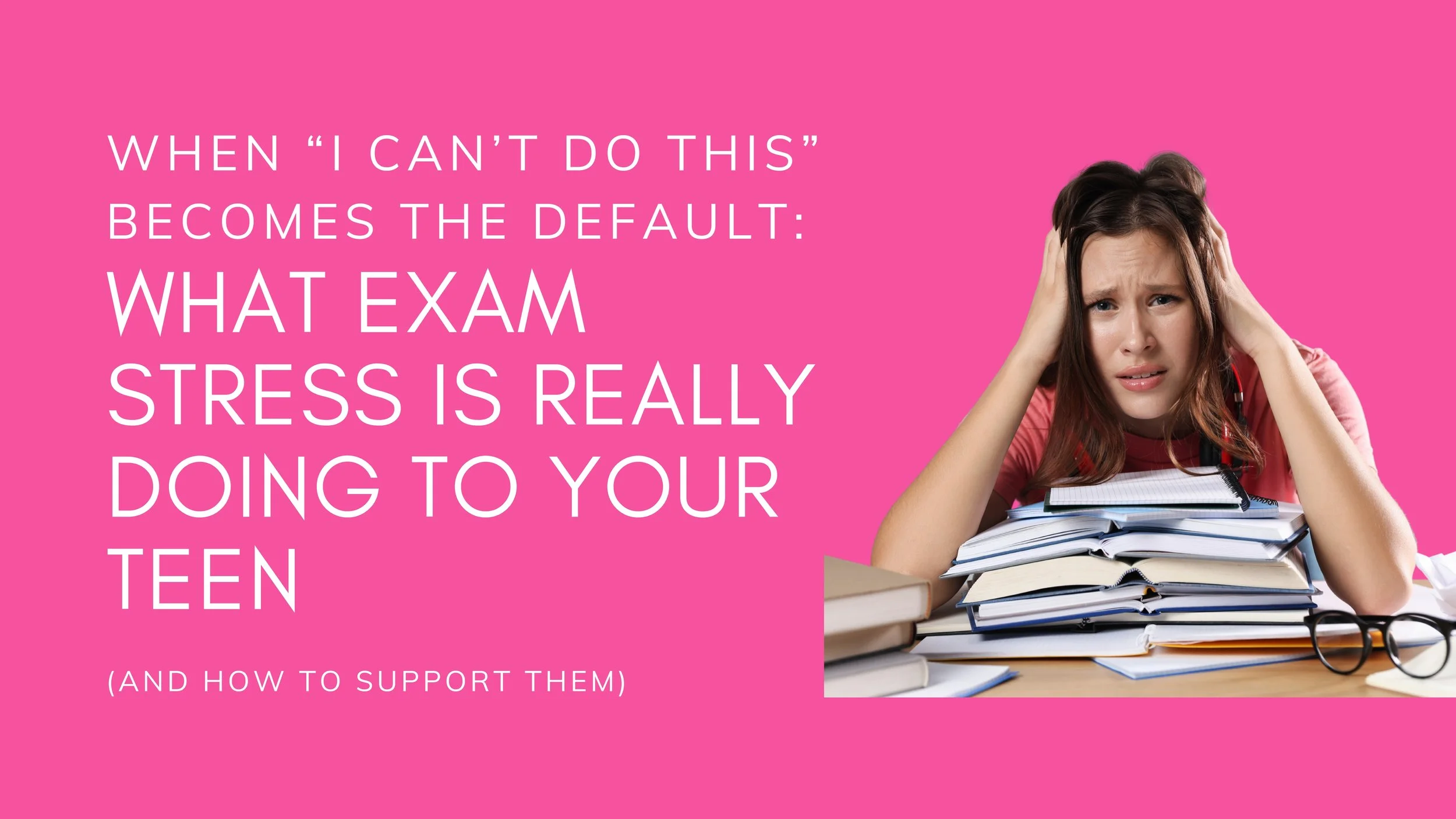
You start to hear phrases like, “I don’t know where to start,” or “I can’t do this.” Sometimes it goes a step further: “What’s the point anyway?” And in that moment, it becomes clear that this isn’t simply about revision. Something deeper is going on.
It’s Not Just About the Exam
Most parents expect a certain level of nerves around exams, and quite rightly so. They matter, and it is natural for young people to feel some degree of pressure. What often catches people off guard, however, is how much this stress spills over into the rest of daily life.
It is not confined to a desk or a revision timetable. It shows up at bedtime, when their mind refuses to switch off. It appears in the car, when they fall unusually quiet and don’t want to talk. It surfaces in the kitchen, when something small triggers a disproportionate reaction, or in those moments where they seem to shut down entirely and disengage.
Some teenagers become irritable, snapping over things that would not usually bother them. Others withdraw, keeping everything to themselves. Some appear to be avoiding the work altogether, while others throw themselves into constant revision but still feel as though it is never enough.
From the outside, it can be difficult to make sense of. You can see they are struggling, but it does not always look the way you expected it to.
“I Can’t Do This” Isn’t About Laziness
This is the part that often gets misunderstood.
When a teenager says, “I can’t do this,” it is very easy to interpret it as a lack of effort or a reluctance to try. It can sound like avoidance, or even a touch of dramatics.
But more often than not, it is neither of those things.
It is overwhelm.
When everything starts to feel like too much, the brain does not respond by working harder. In fact, it tends to do the opposite. It slows down, becomes stuck, and struggles to think clearly. Concentration drops, memory becomes harder to access, and even simple tasks can begin to feel disproportionately difficult.
This is why you might notice them staring at a page without taking anything in, starting something only to give up quickly, or going round in circles with the same thoughts. On the surface, it can look like avoidance, but underneath it is usually a system that has simply reached its limit.
Not because they do not care, but because their capacity has been exceeded.
This is not just anecdotal. Information from the NHS highlights that anxiety can affect how we think, including our ability to concentrate and process information, particularly when we feel overwhelmed. You can read more on the NHS website here.
The Bit That’s Hard for Parents
This is where it becomes particularly challenging.
Your instinct, quite naturally, is to help. You want to reassure them, encourage them, and remind them that they are capable. You want to take some of what they are feeling and make it easier.
So you find yourself saying things like, “You’ll be fine,” “Just do your best,” or “You’ve revised loads.” And you mean every word.
But when someone is overwhelmed, those kinds of responses do not always land in the way we hope. It is not that they are not listening - it is that their brain is not in a state where it can fully take it in.
In that moment, what they need is not more information. They need to feel calmer.
What Helps in the Moment
When a teenager is overwhelmed, it is very easy to feel as though you need to find the right words or fix the situation quickly. In reality, what tends to make the biggest difference is something much simpler: a calm, steady presence.
In psychology, this is often referred to as co-regulation — the idea that our nervous systems respond to the people around us, and that a calmer presence can help someone begin to settle. This is a well-established concept in emotional regulation research, particularly in work exploring how supportive adult relationships help young people manage stress responses. The Center on the Developing Child at Harvard University, for example, highlights how consistent, calm support from adults plays a key role in helping children and adolescents regulate their emotions. You can read more about this here.
Although we often associate this with younger children, it does not disappear in the teenage years - it simply becomes less visible.
When your teen is struggling, your tone, your pace, and your response all send subtle signals about safety. If you are able to remain relatively steady, it gives their system something to orient towards. It communicates, without needing to be said explicitly, that things can settle.
This does not mean getting it right all the time, or never feeling frustrated. It simply means that, where possible, you aim not to match the intensity of the moment.
Alongside this, it can help to gently bring the focus back to something manageable. Rather than tackling the entirety of the exam or the full revision plan, it is often more effective to narrow things down to the next small step - something that feels possible, rather than overwhelming.
The aim is not to say the perfect thing, but to reduce the intensity just enough for their thinking brain to begin to come back online.
A Final Thought
If your teen is finding this time of year difficult, you are not imagining it, and they are not failing.
This is a very human response to a very intense period. The expectations, the build-up, and the emotional load can all combine in a way that feels difficult to manage, even for young people who are usually confident and capable.
That does not make it easy to watch. But it does mean there is nothing fundamentally “wrong” with them.
And it does not mean you have to simply wait for it to pass.
If You’d Like Some Extra Support
This is exactly what I am supporting teens with at the moment - helping them feel calmer, more in control, and better able to cope with exams without everything feeling so overwhelming.
I have created a live online workshop, The Exam Calm Toolkit, where I share simple, practical tools they can use both at home and in the exam itself.
If it feels like something that could support your teen, you can find more details here.
